Employee engagement activities are under more pressure than ever. Hybrid teams, generational shifts and rising expectations around purpose at work have left many companies running through old playbooks that no longer move the needle. Cleanup events are increasingly part of the answer. Done right, a single cleanup day or a recurring cleanup programme drives measurable improvements in team bonding, sense of purpose and retention. This post explains why, what makes cleanup events especially effective, and how to bring them into your engagement strategy without it feeling forced.
The employee engagement gap in 2026
Workplace engagement has stagnated globally. Industry-wide research consistently shows the same picture: fewer than one in four employees describe themselves as fully engaged at work and the gap has widened since the shift to hybrid working. Standard team building tends to underdeliver because it focuses on activities (escape rooms, bowling, paintball) rather than meaning. Activities entertain. Meaning sticks.
The teams that buck the trend share three traits: they meet in person regularly, they share a sense of purpose beyond the work itself and they have visible markers of progress. Cleanup events deliver all three in a single afternoon.
Why purpose-driven activities raise engagement
The link between purpose and engagement is well documented in organisational psychology. When employees see their effort connect to a tangible outcome that matters beyond profit, their commitment to the workplace deepens. A cleanup is one of the rare team activities that ticks every box on that list:
- Meaning. You can see exactly what you accomplished. The bag is full. The trail is clean.
- Autonomy. Everyone chooses what to pick up, how fast to move, who to pair with.
- Connection. Walking and cleaning side by side strips away job titles. Senior and recent hires pick up the same trash.
- Competence. No skill required. Everyone can contribute, which is rare in team building.
What makes cleanup events especially effective
Beyond the engagement mechanics, cleanup events have practical features that help them outperform standard team building:
- Cross-functional mixing. Cleanups naturally mix people who don’t usually work together. Operations, marketing, finance end up on the same trail. One holds the recycling bag, other the cigarette butts bottle.
- Shared outcome. At the end of the day the bags are weighed and counted. The number itself becomes a team artefact, often shared on LinkedIn and internal channels.
- High authenticity. Nobody looks polished after two hours of picking up litter, which is exactly what makes the photos and stories feel real.
- Photo-worthy and shareable. Before-and-after shots of a cleaned riverbank or trail are the rare team content that does not feel staged.
- No skill barrier. Employees of every age and ability can take part, which is rare in outdoor team building.
- Built-in tie to ESG. Unlike most team activities, cleanup events double as content for the sustainability report.
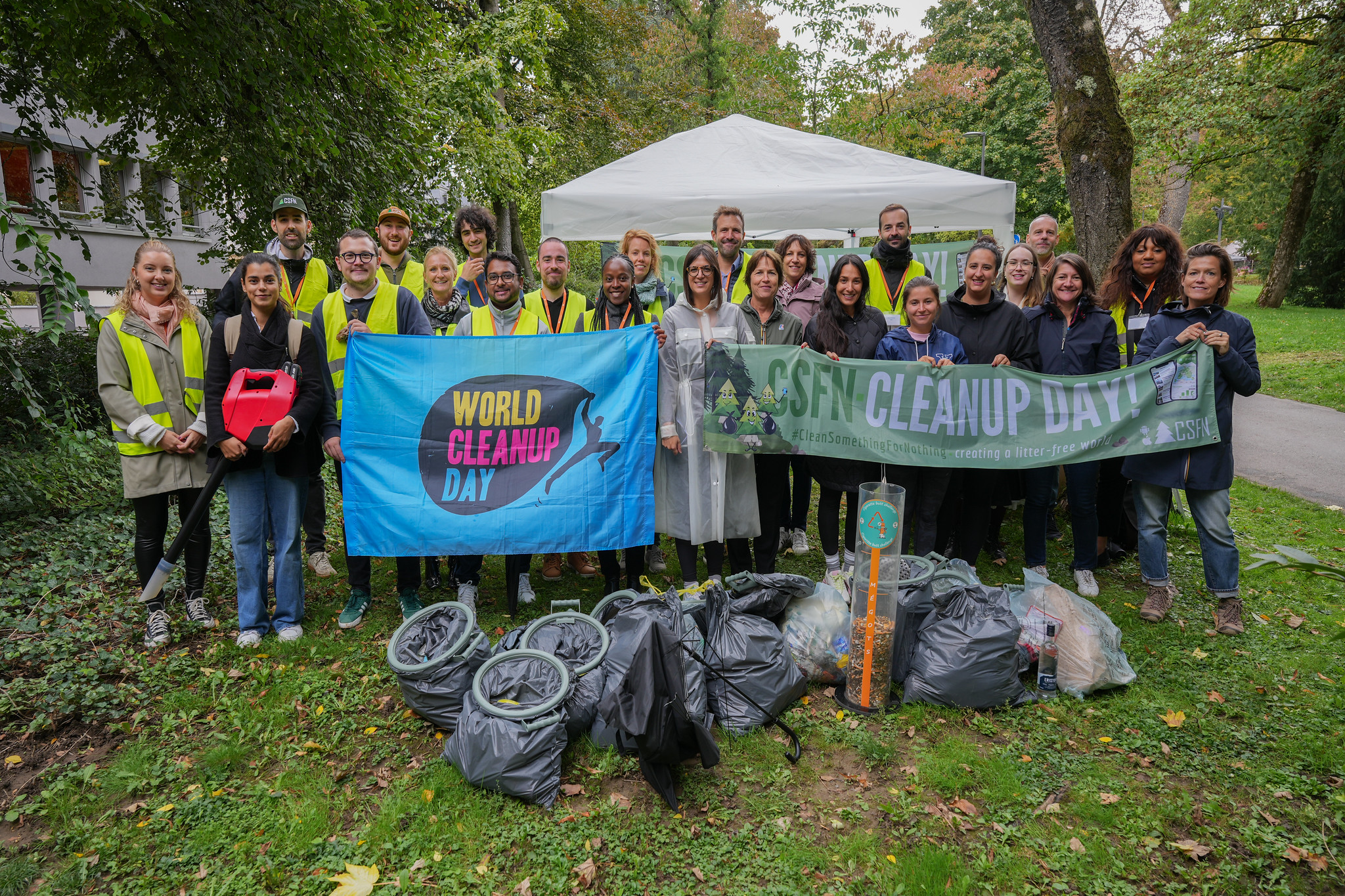
Companies that have run cleanup events with CSFN often comment that the day’s energy spills into the following weeks. Teams talk about it. New hires hear about it. Engagement scores in the cohort that participated tick upward in subsequent surveys.
How to measure the engagement impact
If you want to defend the budget internally, measure the impact properly. Useful metrics include:
- Pre and post-event pulse survey. One or two questions before and a week after. Standard questions on connection to colleagues and pride in the company.
- Repeat participation rate. If you run a second event, how many people from the first one come back? A high return rate is a strong engagement signal.
- Internal social shares. Track posts, reactions and comments on the company intranet, LinkedIn, or internal channels.
- Cross-team mixing. Use the participant list to check whether the event mixed teams that don’t normally collaborate.
- Sentiment in next engagement survey. Watch the next cycle for movement on questions related to purpose, pride, and connection.
The CSFN app already captures the physical impact data (kilograms, photos, locations). Combined with these engagement metrics, you get a complete picture of the activity’s value to the business.
Bringing cleanup events into your engagement strategy
One-off cleanup days are useful. Recurring programmes are transformative. A few patterns work well:
- Anchor cleanups to calendar events. World Environment Day on June 5, Plastic Free July, World Cleanup Day on September 20, Earth Day on April 22. The dates give your communications team a natural narrative hook.
- Run quarterly small events. A 120-minute cleanup near the office once a quarter keeps the rhythm without becoming a logistical burden.
- Layer in Pick N’ Plant. Pair the event with a Pick N’ Plant tier so each kilogram collected is matched by a tree planted. The story doubles.
- Rotate team leadership. Different team members organise different events. The act of organising itself raises engagement.
- Tie cleanup days to onboarding. New hires who participate in a cleanup event in their first 90 days report stronger connection to the company and colleagues.
The Why Cleanups page on the CSFN site goes deeper on the broader environmental case, but for engagement purposes the practical message is simple: cleanup events compound. Each one builds on the last.
How to run your first one with CSFN
For Luxembourg-based teams, the simplest path is the Team Building in Luxembourg programme: CSFN handles the logistics, equipment, briefing and impact reporting. Your only job is to invite the team and show up. For international teams or remote-first companies, the corporate cleanup service can support cleanups in multiple cities and consolidate the data into a single dashboard.
Independent recognition adds confidence. The CSFN model has been featured by UNESCO and listed as a member of IMS Luxembourg, the country’s leading network for corporate responsibility.
Key takeaways
- Standard team building underdelivers on engagement because it focuses on activities, not meaning.
- Cleanup events combine purpose, autonomy, connection, and visible outcomes: the four ingredients of high engagement.
- They are inclusive, photo-worthy, and naturally cross-functional.
- Measure the impact with pre/post surveys, return rates, and engagement-survey movement.
- Anchor cleanups to calendar events and run them quarterly for compounding effect.
Plan your first cleanup engagement event
If your team is in Luxembourg, the fastest start is to get in touch with us to clarify any questions and discuss preferred dates.